Why have regular laser-assisted dental cleaning?
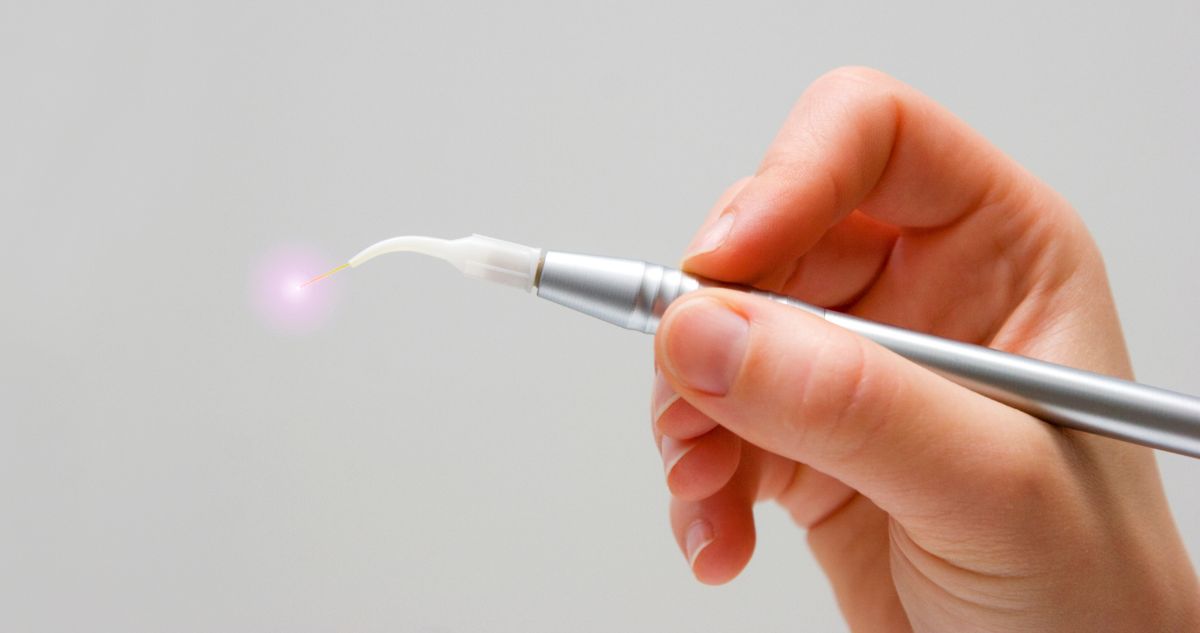
Using a laser during scaling minimises the risk of inflammation, eases pain and discomfort on the day of treatment and speeds tissue regeneration.
Brushing your teeth at home, even carefully and thoroughly, is not enough on its own to maintain good oral hygiene in the long term.
Plaque is a thin film of bacteria on the teeth that forms naturally as food breaks down. Brushing alone cannot remove all of it. As plaque accumulates, minerals in saliva harden it into tartar.
How long does a dental cleaning with laser treatment take?
At our clinic, we usually set aside 45 minutes for a dental cleaning with laser decontamination. During the appointment, we remove tartar with an ultrasonic scaler, clean your teeth and use the laser along the gum line. If your gums need further treatment, we explain what it involves and whether you need another visit.
What happens if tartar builds up?
Tartar tends to build up where brushing is difficult, especially along the gum line and around implants and bridges. It can also collect on fillings, dentures and braces. How quickly it forms depends on factors such as your diet and saliva flow. Braces, crowded teeth and smoking can all favour the build-up.
If left in place, tartar can lead to bad breath, inflamed or receding gums, tooth decay and periodontal disease (periodontitis).
Signs that you may have gum disease ››
How often should I have tartar removed?
Alongside good brushing at home, the clinic recommends visiting your dentist to help prevent tartar build-up and gum disease, typically every six months for a check-up and professional scaling.
Your dentist may recommend shorter intervals if you have inflamed, receding or bleeding gums, gum disease, implants or other dental restorations. In these situations, build-up can carry a higher risk of further problems.
Studies have shown that professional scaling does not damage tooth enamel, regardless of how often scaling is needed.
Scaling is a straightforward dental treatment. Performed regularly, it can considerably extend the life of your teeth and protect your gums from serious disease. A cleaning visit can also reveal hidden problems at an early stage, when treatment can prevent them from getting worse.
What happens during scaling?
Routine scaling involves a few simple steps during a single dental visit. If your teeth are particularly sensitive or deposits have built up in a tender area, the dentist may offer a local anaesthetic to ease discomfort.
Before cleaning, the dentist checks the gums with a periodontal probe. If there are deep pockets around the teeth or other signs of gum disease, the dentist adjusts the depth of cleaning and may recommend further periodontal treatment.
1. Ultrasonic scaling
An ultrasonic scaler breaks up larger deposits on the teeth, along the gum line and just inside the gum crevice.
2. Air polishing
A jet of fine particles rich in sodium bicarbonate and glycine thoroughly cleans the teeth by air polishing. This removes plaque, microscopic tartar deposits, discolouration and stains, including in hard-to-reach areas.
3. Professional polishing
The dentist polishes the teeth with a mildly abrasive paste and a rubber cup to leave a completely smooth surface that prevents plaque from building up again.
How does laser-assisted cleaning differ from conventional scaling?
A conventional clean ends after these three stages. Your teeth should feel clean and polished and may look a little brighter. Depending on the depth of cleaning, you may notice sensitivity to hot or cold food, tender gums when you eat or a change in taste for a few hours or into the next day.
With laser-assisted cleaning, there is one additional stage:
4. Laser decontamination
This is a painless procedure in which the dentist passes a laser beam along the gum line. It has two aims: to eliminate bacteria from the gum crevice and to stimulate the gum tissue involved in the earlier stages of scaling.
After laser-assisted cleaning, your teeth feel just as fresh, clean and polished, with several additional benefits:
minimal residual gum discomfort or pain after treatment
a return to your usual activities without any change in the taste of food
a reduced risk of inflammation after the procedure because bacteria have been eliminated
faster gum regeneration through biostimulation
less gum bleeding when brushing after laser-assisted scaling
A practical tip After laser-assisted cleaning, the clinic recommends replacing your toothbrush to avoid transferring bacteria from the old brush back onto your teeth.
---
Key points
Scaling is a straightforward form of dental care that is often put off for longer than intended.
Professional cleaning plays an important role in preventing disease affecting the teeth, gums and supporting tissues.
Using a laser during scaling minimises discomfort and the risk of inflammation, and accelerates tissue regeneration.
Regular scaling gives us a chance to detect problems early, before you can see or feel them. This gives us a good chance of treating them effectively at minimal cost, sometimes in just one visit.
Make regular professional cleaning part of your routine. After a clean, ask your dentist when to book the next one.
To book an appointment, call +40 774 678 223

Dr Mihai Iorgulescu
Specialist in general dentistry
Dr Mihai Iorgulescu has a particular interest in dental technology. He takes a meticulous approach to laser-assisted dental treatment and to restorations using modern materials.